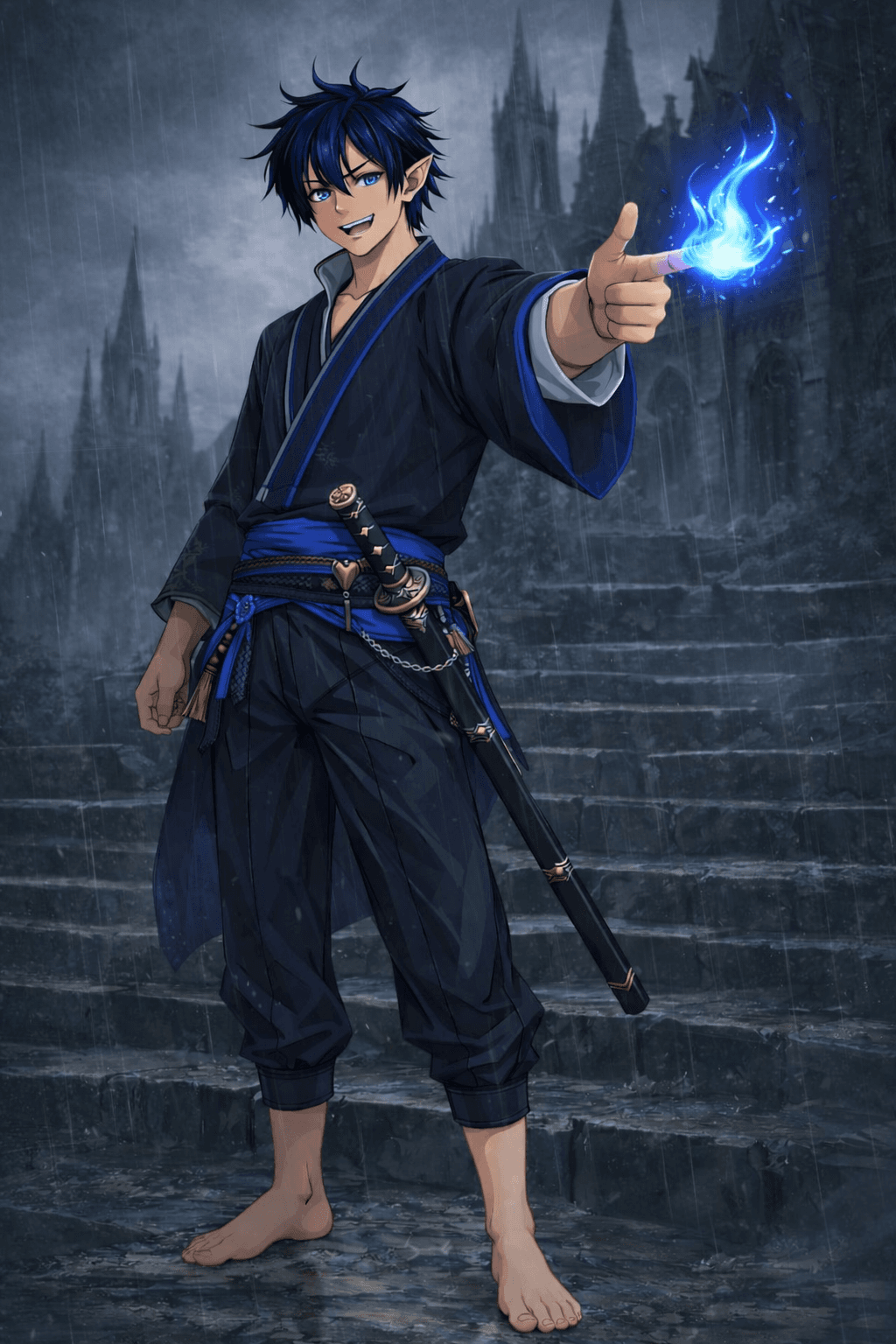
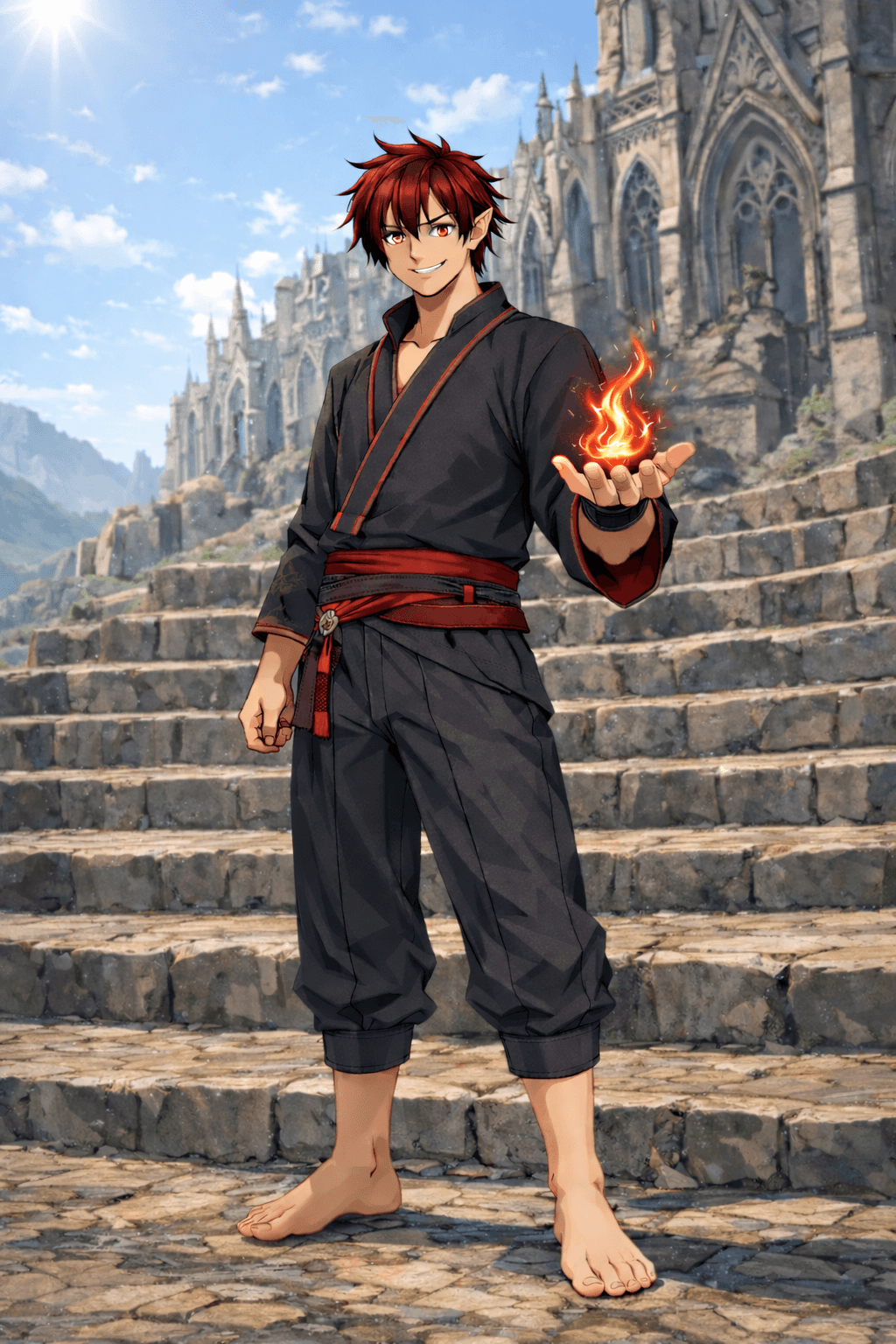
Prologue 3: I'm sorry
Village on the Northern Slope of Tanabe, Afternoon of January 27 — 1700 A.D.
Seijuro did not react to the doctor's two words, not because he had not heard them — he had heard them with a wounding clarity, the way one hears the opening verses of a sutra at someone else's funeral — but because his body, drilled for more than a decade not to answer the first stimulus of fear, refused to admit them. He remained on his feet in the half-light of the tatami room, his haori soaked through from the run from the woods, his hands hanging at his sides and his shoulders tilted slightly forward, as if the weight he had set down when he laid Otsuru on the futon were still, somehow, resting upon them. The incense the doctor's wife had lit minutes earlier rose slowly: a gray, twisted thread that seemed to hesitate between staying in the room or passing through the paper of the window and losing itself in the cold January air.
The doctor avoided his gaze the way one avoids a fire still crackling. He had glimpsed the scar on the husband's left side, where his haori had fallen open — a line of steel badly closed, of months, not days — and he had understood, even before touching the skin, that this man was no ordinary husband, and that what he was about to say was going to break something in him that he, a country physician, would not know how to mend.
"She has been dead a good while, officer. The fever took her from within; the hemorrhage, from without. By the time the two of you came through that door there was nothing to be done."
He said it without circumlocution but with softness, with the quiet plainness of a man who has learned over thirty years in a village that deceiving the bereaved does not console him but only delays the blow and, by delaying it, makes it harder.
Seijuro listened to the whole sentence without blinking, and only when the doctor had finished, only then, did he shake his head once.
"No."
He said it in a tone that was not a challenge to the doctor, nor a protest against the fact; it was an order given to the universe, pronounced as he had pronounced for years the orders soldiers had no right to dispute: without raising his voice, without barely moving his lips, with a density in every syllable that froze the air around him. Then he leaned over the futon, pressed his forehead to Otsuru's, and closed his eyes. The skin was cold. Too cold. There was no trace left of the heat he had felt half an hour before, while running with her in his arms along the cedar path.
Otsuru.
No answer.
Otsuru.
Still none.
He straightened slowly and looked at the doctor with reddened eyes, without a single tear, because men like him do not weep in public and he was not going to begin in a stranger's house. The doctor stepped back without realizing it. The sanba, the doctor's wife and midwife of the valley, appeared at the threshold with a bowl of hot water in her hands, stopped at the sight of the scene, and understood at once without needing anyone to explain. She set the bowl on the floor, knelt beside the futon, and took Otsuru's pulse with two fingers; after a few seconds she shook her head, the smallest shake. The signal was so brief a civilian would have missed it. Seijuro, who had read smaller signals on larger battlefields, understood it.
He struck his chest with the edge of his left fist. Not with fury. With the precision with which an enemy would have struck him. Once. Again. Then he was still, and in that second of stillness he accepted what the doctor had told him and what he had been denying since the moment he had set Otsuru down on the futon, and he accepted it in the only way he knew how to accept great defeats: with no gesture and no word. Pain, for a man like him, was a familiar language. It did not interrupt the conversation, but there were words in that language that had not been spoken in his life until now, and now he was beginning to speak them.
"It is my fault."
It was no statement addressed to anyone. It was a record.
The doctor did not correct him. There were no words that could ease what had just broken.
Cedar Clearing on the Mountainside, an Hour's Walk from the Village. Morning of January 28, 1700
The burial Seijuro arranged with the same discipline with which he had drawn up the formations of his company for years, and he did not delegate a single task, because he understood that to delegate the funeral would have been to delegate the guilt as well, and the guilt was a property exclusively his that he could not share with anyone. He oversaw the washing of the body in a wooden tub the doctor lent him without charge, laid out with his own hands the white kimono of the dead, arranged Otsuru's hair, combing it back with a bone comb that one of the villagers had brought without anyone asking him to. Each gesture was a way of holding back the irremediable: if every layer of cloth were placed to perfection, if every strand of hair were arranged in the exact place, perhaps that afternoon could be postponed. It could not.
A Buddhist monk from the nearest temple, sent for at dawn by the doctor, came to the clearing with the implements of the rite wrapped in a gray bundle. He was an old man with a frayed kesa and the eyes of a still lake; he spoke little, and when he spoke he did so with the liturgical cadence of a man who has recited the same verses over the same coffins for half a century and no longer needs to lay any stress on them for them to be heard.
"The kaimyō I will prepare myself," he said, referring to the posthumous name. "A woman who dies giving life to a male child deserves a long name."
Seijuro nodded without speaking.
Some villagers came down from the foot of the mountain and kept their distance, with that mixture of curiosity and respect that coastal villages reserve for the misfortunes of others which they sense to be greater than their own. They knew that the officer burying the woman was a Nakata and that the Nakatas had fought akuryō in three provinces, and some of the older among them even remembered Jirōbei from missions of his youth; but that morning, beneath the white mist that filtered through the cedars, they were not looking at an officer. They were looking, without knowing how to put it that way, at a man who had lost the only battle he had not been trained to lose.
The monk recited the sutra. Seijuro knelt before the simple pine coffin, his back as straight as a sentry's, his knees together, his hands resting on his thighs and his gaze fixed on the unlacquered wood of the lid. He did not weep. He did not tremble. The coins for the journey to the next world were placed on Otsuru's chest, the mortuary tablet was set beside her head, and then came the moment Seijuro had been postponing with the meticulousness of every previous gesture: the lid was closed, the ropes drew tight, and the coffin began to descend into the pit dug in the damp earth.
The villagers cast in the first shovelful.
The earth struck the wood.
A dry sound.
Repeated.
Final.
When the last shovelful had covered the mound and the monk, with a brief bow and no words wasted, withdrew down the path that led back to the village followed by the villagers, Seijuro stayed kneeling before the freshly turned earth, and no one dared tell him to rise. The wind stirred the high tops of the cedars, a dry January wind that carried wisps of incense and fragments of the last verses of the sutra, and the murmur of the forest was like a distant prayer no longer addressed to anyone in particular.
"I'm sorry."
It was no word cast into the air.
It was a confession.
And then, like a man opening a chest he has carried shut for years because he knew opening it would hurt him, Seijuro began to remember.
Training Camp of the Japanese Army — Hiroshima. Late Winter 1690, a Few Weeks Before the Transfer to Osaka
There were few things in the Japanese army as exact as the silence that fell over a parade ground before an evaluation bout, and that morning — Seijuro's last morning at the Hiroshima camp — the silence was more exact than usual, because the officer he was about to face was not one of the regular instructors but a veteran captain brought down from Kyoto to take the boy's measure, and because everyone gathered around — instructors, senior cadets, two staff aides sent from Osaka who were taking notes in small books — knew that what was about to happen in the next minutes was not just another exercise but a file that would sign itself.
Seijuro stood at the center of the parade ground with empty hands.
The evaluation uniform was the regulation issue of the army: green field tunic, dark tactical trousers, calf-laced field boots, a service belt with no weapons hanging from it. He carried no weapons — cadets had the right to bear regulation weapons in the exercises — because Seijuro had renounced them on the previous day's report sheet with a dry signature and no explanation that had made the duty officer raise an eyebrow. Fists, he had written in the box for the chosen weapon, in the same clear hand with which he filled out ammunition inventories. The duty officer had read the box three times before stamping the report.
In front of him, three paces away, the captain brought down from Kyoto held a tactical knife of regulation issue: black blade, ribbed rubber grip, some eight inches of matte edge. His name was Fujibayashi, he was somewhat over forty, he had a scar that crossed his left cheekbone like a badly sewn seam, and a reputation in the officer corps that was spoken of in low voices and with respect. He had killed three akuryō in hand-to-hand combat, he had instructed for more than a decade at the Kyoto academy, and he was looking at the boy with the exact mixture of curiosity and self-assurance with which one looks at a prodigy before confirming whether he is one.
The supervising officer, a commander from the Hiroshima base with twenty years of service, took up his place at one side of the ground and raised his voice without raising it more than necessary, because he did not need to.
"The rules are those of the evaluation regulations. Combat to surrender, loss of consciousness, or incapacitating wound. The candidate has chosen not to bear a weapon. Captain Fujibayashi keeps his regulation blade. If the candidate wins, the transfer is processed; if he loses, he repeats the semester. Any objection?"
Seijuro did not blink.
Fujibayashi gave a half-smile. It was not a mocking smile; it was the short, professional smile with which veterans prepare themselves to do an uncomfortable job well.
"None, sir," Fujibayashi said.
"None," Seijuro said.
He said it without modulating his voice, without raising it, without answering with more words than were strictly necessary, and in that clean, unadorned none there was, for the officers who had been observing him for three months, an amount of information that other cadets would not have managed to convey in a full speech. The supervisor nodded once and, with a sharp movement of the right hand, gave the order to begin.
Fujibayashi advanced first.
He did so without haste. One step, two steps, knife in the right hand with the blade carried slightly low, the left open and forward as a counterweight, the classic stance of asymmetrical combat. Seijuro did not give ground. He took up his guard — left hand closed in a fist at the height of the cheek, loaded like a hammered projectile; right hand open, palm turned toward the enemy, half extended, farther from the body — and waited. To wait, for a Nakata, was not patience: it was tactics.
Fujibayashi's first feint was a high cut toward the boy's left shoulder. It was no real attack; it was a measurement. Seijuro understood it was a measurement at the exact instant the blade began to move, and he limited himself to leaning his torso half a hand's breadth back, enough for the steel to whistle two fingers' breadth from the tunic without grazing it. He did not answer. Fujibayashi pulled back one step, read the non-movement, and knew that the boy was not going to answer to measurements. He changed his plan.
The second attack was a feint: a thrust at the throat with the unarmed hand, a real strike with the right toward the waist. Seijuro read this one too. The edge of his right forearm — the open hand, the one that in the Nakata guard is sacrificed before the left — went outward at a closed angle and struck the back of the captain's wrist with a muffled crack; the knife did not fall, because Fujibayashi was too veteran to lose a weapon over a deflection, but the arm jolted slightly off-axis and Seijuro had, for half a second, the opening he needed. He did not take it. He returned to the guard, drew back half a step, and waited.
There was a muted murmur among the officers with the notebooks.
Fujibayashi understood at once: the boy did not want to win in the first two exchanges. He wanted Fujibayashi to believe he was going to win in the next two. There were cadets who had style at sixteen, and others — very few — who had something harder to teach: they knew how to read an adversary. Fujibayashi had known few officers in his life who at forty read the way that boy was reading at sixteen. It pleased him, and it unsettled him, in equal measure.
The third exchange was fast.
Fujibayashi pressed in with decision this time: two diagonal cuts, left and right, and, taking advantage of the fact that Seijuro had given a step to read both, a straight thrust toward the abdomen. The thrust was the real one. It was going to land. It was going to land on any other cadet of the semester. Fujibayashi knew it as he launched it and allowed himself, in the intervening millisecond, to relax the right shoulder a notch, already preparing the gesture with which he would stop the edge a finger from the cadet's skin so the evaluator would mark it as a valid touch without wound.
That single notch of relaxation was the only error he made.
Seijuro did not yield the abdomen.
He turned the torso on the left hip — barely enough, not a degree more — so that the black blade slid past, pressed against his side, brushing the cloth of the tunic without finding flesh. In that turn, the boy's left shoulder came into line with the captain's jaw at a distance of exactly fifteen inches, and the left fist, which had been waiting three months for that angle, fired without passing through any intermediate process of decision.
A single blow.
Dry.
Final.
Fujibayashi went down on his knees first and on his side after, the knife still in the right hand, his eyes rolled white. He was not dead — Seijuro had calibrated — but he would take several minutes to come back to himself, and when he came back he would not remember the second in which he had relaxed his shoulder. Few humiliations are worse for a veteran than not remembering the exact second of his defeat.
The supervising officer took longer than usual to give the order to end. He gave it at last, his voice a touch drier than at the start.
"Combat ended. Evaluation passed. Send for a doctor for the captain."
Seijuro lowered his guard.
He did not smile.
He did not move toward the fallen man.
He stayed where he was, his hands still at the height of the cheek and the waist, breathing through his nose with a sentry's regularity, and waited for instructions. One of the staff aides from Osaka — a slim lieutenant with a thin mustache — broke off from the group with the notebooks and came up to him with a sealed envelope in his hand.
"Boy," the lieutenant said.
He called him boy because there was no other elegant way to address him at that age, and because what he had just seen would not allow him to call him candidate without feeling ridiculous.
"Immediate transfer to the Osaka base. Rank of full officer. Departure tomorrow at dawn."
Seijuro took the envelope in both hands and inclined his head slightly.
"Osaka," he repeated, without inflection.
The lieutenant hesitated for an instant. Then he added, like a man offering a side detail not on the envelope:
"Your father has been posted there since last autumn. They will be waiting for you at the main gate."
Seijuro said nothing. His expression did not change. Only something at the corner of the right eye contracted faintly for half a second, and the lieutenant, who had been reading officers' faces for twenty years, did not know whether that had been an emotion or a drop of sweat.
He bowed again, turned on his heel, and made for the barracks to gather his things.
Behind him, a field doctor was kneeling beside Fujibayashi and patting his cheek to bring him round. The captain, when he opened his eyes, did not ask who had won. He knew. He looked toward the barracks, toward the slim figure receding through the fine mist of Hiroshima, and the first thing he said, in the thick voice of an aching jaw, was a sentence the staff aides from Osaka thought worth writing down in their notebook:
"Send word to General Nakata. His son is on his way to see him."
Main Courtyard of the Osaka Military Base. Early Days of Spring 1690
Three days later, when Seijuro crossed the wrought-iron gate of the Osaka base with his pack on his shoulder and the sealed envelope tucked in the inside pocket of his tunic, what awaited him in the main courtyard was an informal welcoming party that would have made any normal recruit smile and that in the end made even him move one corner of his mouth a hair's breadth. Half a dozen veteran officers had come, men who had served with Jirōbei in old campaigns: two commanders, a couple of captains in their forties, the master sergeant of the quartermaster's corps — who was no officer but had wormed his way by squatter's right into that kind of welcome since time immemorial — and, set half a step ahead of the group, with the same straight back his son had just inherited from him and a face any stranger would have taken for severe but which Seijuro could read from twenty paces, Jirōbei Nakata.
The officers broke into a collective laugh before Seijuro had even reached the middle of the courtyard.
"Look who's planted himself here!" cried Raisuke, one of the commanders, a broad-shouldered man with cheeks reddened by wind and other things, a man who in the years to come was to be commander of the army in Osaka. "The son of old Nakata, sixteen years just turned, already a full-rank officer, like his father at seventeen!"
"Seventeen and a half," Jirōbei corrected, with a one-sided smile that did not pass the corner of his mouth but was enough to open his whole face for any man who knew how to look at him.
Raisuke burst into another laugh and slapped Jirōbei on the shoulder with his broad palm. Jirōbei, for once, let himself be pushed half a step without resettling himself. The quartermaster's sergeant produced from behind his back a demijohn of warmed sake, too early for the hour and too good for the daily uniform, and began filling the small wooden cups someone had set out on a barrel turned on end beside the gate.
Seijuro had stopped three paces short of the group. He set the pack down with care, gave the briefest of bows — the formal one, not a finger's breadth more — and straightened up with the same calm with which he had bowed.
"Sir," he said, addressing Raisuke. "Sirs."
Only then did he look at Jirōbei.
Jirōbei stepped forward two paces and stopped in front of him. He did not embrace him — the Nakatas did not embrace in public, and perhaps not in private either — but he laid the broad palm of his right hand on the back of his son's neck, with a brief firmness that lasted barely two seconds and that, for the two of them, weighed more than any embrace. Seijuro, for the first time that morning, lowered his chin half an inch. It was the gesture of a son, not of a subordinate.
Jirōbei pressed the back of his neck a little more and let go.
"You took your time," Jirōbei said.
"I left at dawn, Father."
"You took your time all the same."
He said it with a parodied gravity, the sake not yet poured into his cup, and Seijuro — who had not laughed in public since he could remember — let out through his nose a short snort that, in the Nakata tongue, was the equivalent of a belly laugh.
"Jirōbei," Raisuke said, handing him a full cup. "Your boy has just laid out Fujibayashi with one blow. A single blow. The report came in yesterday. In Kyoto they're still arguing whether to sign it or open it again. Aren't you going to say anything?"
Jirōbei accepted the cup. He looked at it for an instant, as though calculating something about the temperature of the sake, and raised it slightly toward his son.
"I am going to say something, yes," he answered. "I am going to tell my son that the third time he lays out a captain of the army with one blow, I will start to think twice before I sit down to breakfast with him."
The officers laughed long. Jirōbei laughed too, with a contained, dry, brief laugh that Seijuro had not heard in years. And Raisuke, who was the loudest of the group, put a heavy arm around Seijuro's shoulders and shouted that this had to be christened the way God intended, and that tonight the three of them — the four, Jirōbei, come on — were going to the honjin in the southern district, one of the few things in the city worth the walk.
Jirōbei accepted the invitation with an inclination of the head. He had not accepted one in years. He did not comment on the reason for his change of mind.
When evening had fallen and the officers had scattered to the barracks to prepare, Jirōbei drew up to his son and, for an instant, set his hand again on the back of his neck.
"Tomorrow, at five, on the field. Don't be late."
"No, Father."
"And tonight, if the others get you drunk, drink water on the sly and leave the cup full. It's an old trick. Your grandfather taught it to me."
Seijuro nodded, without answering in words.
The hand at his nape withdrew. Father and son parted without farewells, because they had no need of farewells when they were going to see each other again three hours later in the same place. But the officers with the notebooks, who were still writing in a corner of the courtyard, set down something that was not in the regulations: that old Nakata had that afternoon accepted an invitation he had been turning down for five years.
Honjin in the Southern District of Osaka. That Same Night, Spring 1690
The honjin stood at the end of an alley of cloth merchants that by day sold bolts of fabric and by night turned into a passageway of red lanterns hung from low eaves, and the building stood out from its neighbors because it had two stories instead of one, a dark blue curtain over the door with the family crest embroidered in tarnished silver, and, on either side of the threshold, two lanterns lit as a sign that the owner — a third-generation innkeeper — was that night accepting official guests and not-so-official officers. The four Nakata-and-companions — for the officers of that party, all together, looked almost like an extended family — passed through the curtain one behind another with a brief greeting to the man at the door, who recognized them before any of them opened his mouth.
Inside, the honjin had the usual layout: a great tatami hall with low tables arranged in three rows, a side corridor leading to the private rooms on the upper floor, a small interior garden with a stone lantern lit, and at the back the kitchen with two older women hurrying in and out with steaming trays. Some ten tables were occupied; the majority by well-off merchants, and two by officers from another company who saluted the newcomers with a gesture from the far end. The broad-shouldered commander, without consulting anyone, picked the table nearest the garden — the place of honor — and dropped down onto the cushion with a thud that drew the attention of the kitchen without him needing to call anyone.
"Here," he said, slapping the table with the open palm. "And don't bring me the cheap sake you serve to the merchants, because tonight we celebrate a Nakata."
Seijuro sat down last, to the left of his father, at the end of the table closest to the corridor. He laid his two hands on his thighs, his back straight, his chin slightly low, and waited. Jirōbei sat in the place facing the garden, crossed his legs with an old gesture that had not left him in twenty years, and looked at his son with a half-raised eyebrow that might have meant he was proud of him or might have meant nothing.
And then, through the curtain of the corridor, came the third of the five sisters.
She did not laugh as the two older ones laughed. She did not bow in exaggerated reverence. She was not seeking the officers' attention: she simply crossed the hall with a tray between her hands, passing among the tables with the precision and the calm of one who knows exactly what place she occupies in the world and does not need to dispute it. She was sixteen years old, the same as Seijuro, in an ivory mid-season kimono with a discreet sakura embroidery on the left sleeve, and her hair gathered in a low chignon held by an unadorned comb of dark wood.
Seijuro, who had seen enemies dead who were taller than he was and who had three days earlier left unconscious a captain of the Kyoto academy with a single blow, felt for the first time in his life something tighten his chest with no identifiable tactical motive. It was not desire, or it was not only desire. It was certainty.
The girl approached the table with the tray loaded with cups and a small jug. She knelt at the head of the table in a single, precise motion and began pouring in order of rank: first the broad-shouldered commander, then Jirōbei, then the captain seated to the right. Seijuro was watching her. Not with the impertinent gaze of the new recruit on his first visit to a honjin: with a fixed, long gaze, not impolite but neither distracted, which the girl detected without lifting her eyes from the cup she was filling. She did not blush. She did not falter. She finished the captain's cup, turned toward Seijuro, leaned slightly to pour for him, and as she did, lifted her eyes half an inch and held his.
A second.
Two.
Three.
More than etiquette advised.
Seijuro half rose from the cushion, which, in a honjin in the middle of dinner, was incorrect.
"What is your name?"
The officers fell silent at his back.
The girl did not drop her eyes when she heard him. She answered with the jug still in her hand and without hurrying her voice, as though a newly arrived officer in Osaka questioning her in the middle of a full hall were exactly what she had expected to happen that evening.
"Otsuru."
And she did not smile.
That undid him more than a smile would have.
He sat down again. One of the captains clapped him on the shoulder with a hoarse laugh and told him, lowering his voice, that she was a respectable girl, the owner's daughter, and that one did not court the owner's daughters in that house nor call them by their names across the room. Seijuro did not answer. He looked at the captain for a second with a neutral expression that was not discourtesy but neither agreement, and the captain, seasoned in taverns and campaigns, drank off his sake and let the matter drop.
Jirōbei, from the seat of honor, observed with his cup half raised.
He said nothing. He took a sip.
He took another sip.
And, very slowly, he set the cup down on the table with a careful slowness that Seijuro, for the first time in his life, could not entirely read.
At the end of the dinner, when the officers had taken to singing an old campaign song and the broad-shouldered commander was clapping the captain beside him on the back between bursts of laughter, Otsuru passed the table again with an empty tray. Seijuro waited until she was two paces from him to say, in a low voice, looking straight ahead:
"I will come back tomorrow."
Otsuru did not stop.
But she nodded, with a movement of her head so small that only he saw it, and went on toward the kitchen with the empty tray as though absolutely nothing had been said to her.
When they came out of the honjin, after midnight, Jirōbei dropped back the last three steps of the group, matched his son's pace, and, without looking at him, said in his ear, so low that no one else heard:
"The girl is the third one."
"I know, Father."
"She is the only one who does not laugh."
"I know."
"And she is the only one who has not looked at me."
Seijuro turned his head half a degree.
"She did look at you, Father. When you served the second cup to the captain on the right. The trouble is that just then you were looking at the garden."
Jirōbei did not answer. He took three more steps in silence. On the fourth, without turning his head, he made a short sound through his nose that, in the Nakata tongue, was the equivalent of an amused nod.
"Five tomorrow, son."
"Yes, Father."
And each of them went off to his quarters to sleep what few hours remained before the dawn drill.
The Same Honjin, During the Years That Followed — Osaka, 1690–1696
For the next six years, the silhouette of the young officer Nakata crossing the doorway of the honjin in the southern district became as familiar to the neighbors as the bell of the local temple or the cry of the tofu seller at dawn. The first months made him the object of cautious gossip: an officer too young, too serious, who would order a teapot and occupy a corner table for hours, and to whom the third daughter of the owner served tea with the same unhurried care she would have served it to an eighty-year-old man. Then the gossip thinned out, because the neighbors understood that there was no scandal there to tell, and they replaced it with a silent respect for what was evidently happening.
Because it was happening.
Seijuro visited the honjin whenever his shifts allowed, and sometimes when they did not. He would come back from patrol missions with his tunic caked in dust, walk in without first stopping at his quarters, sit at the same table, and wait for her to have a moment. Otsuru did not make him wait. She would bring him his tea, kneel with the tray on the tatami, and, if the hall was empty, stay a few minutes more. At first they spoke of trivial things; then of less trivial ones; with time, of what they each thought of the world and of the place they would have to occupy in it. They learned to be silent together without discomfort. They learned to recognize, in each gesture of the other, the thought behind the gesture.
Otsuru's father observed the phenomenon for two years with that caution experienced innkeepers reserve for young officers: a boy with a great future may want a wife from another class, a better-placed geisha, the daughter of some daimyō by political alliance; a boy with a great future does not usually choose the third daughter of an innkeeper. After three years, he began to doubt his own caution. After four, he set it aside. The officer Nakata did not bear the constancy of an infatuation but the obstinacy of a man who has made a decision from the first day and is only waiting for the rest of them to catch up to his decision.
Otsuru, for her part, did not rush. In the first months she had kept to herself the marriage proposal Seijuro had made her in the second week — a proposal stated, while she was serving him tea and he had just asked her if she liked children, the way one states a patrol order, without preamble and without ornament, at sixteen years old; she had not accepted it, she had not refused it, she had left it in suspension with the serenity that was characteristic of her nature. She grew with him those years. He grew too. And when, at twenty-two, Seijuro put the same proposal again, this time through the proper channels and before the father, Otsuru asked for two days of reflection out of pure courtesy, but had decided long before that she wanted nothing else but that taciturn, obstinate man who for six years had been entering the hall the way one enters a command post.
The father accepted. The mother wept. The sisters wept too. The eldest brother, who by then was the one keeping the books, embraced Seijuro in a manner that one had to translate from the language of innkeepers into the language of officers to understand was a welcome to the family.
Loyalty to style was a schoolmaster's luxury, no article of the soldier's code: Seijuro, who had never given an inch to the senior officers, had given everything to the household of an innkeeper, and had done so for six straight years, without haste and without doubt.
Recently Rented House, Military Quarter of Osaka — Wedding Night, Autumn 1696
The wedding was simple, intimate, without ostentation, celebrated in the small garden of the paternal honjin on an October afternoon when the leaves of the maples had turned red without warning, and the home in which the newlyweds would spend that very night — a modest house in the military quarter, with new tatami and the still-fresh smell of newly planed wood — was the only gift Seijuro permitted himself. The guests left at dusk, leaving them alone for the first time, and the silence that fell over the house was the particular silence of marriages just celebrated, which is neither a comfortable silence nor an uncomfortable one but one that waits to be named.
Otsuru remained seated on the edge of the futon, her hands resting on her knees, her back straight as always, but her fingers a little tense. Seijuro slid the fusuma shut with the softness with which an officer never closes a door, and knelt down behind her.
"Are you afraid?"
He said it in a voice no soldier of his would have recognized, because it was Seijuro's voice but emptied of authority.
"A little."
"You have no reason to fear me."
"I do not fear you."
Otsuru said it without turning around, with her habitual calm, and only after an instant, as if she had hesitated whether to add what she was about to add, she clarified:
"I am afraid I am not enough."
Seijuro slowly drew aside a strand of hair from the back of her neck. He laid his lips against the skin, just below the ear, and felt Otsuru shiver slightly at the contact.
"You are enough," he said. "You have been for six years."
Then he wrapped an arm around her waist, his broad open hand on her belly, and with the other hand, the left one, began to loosen the obi that held her wedding kimono closed. The sash gave way in two firm movements, neither hurried nor hesitant, and fell on the tatami the way a well-given order falls. The kimono opened. Otsuru, with her eyes closed, let him slide the cloth from her shoulders; the gesture was unhurried, deliberate, and the skin that came uncovered received the cold of the room and, an instant later, the warmth of Seijuro's palms.
He turned her gently, holding her by the shoulders, until she faced him. He looked at her for a second without saying anything. Then, without releasing her shoulders, he kissed her. It was a slow kiss at first; Otsuru parted her lips and Seijuro deepened it with a firmness that was not roughness but decision. With one hand he held the back of her neck; with the other he traced her bare back down to her waist, without hurrying, setting the rhythm himself. Otsuru rested her hands on his chest with the cloth of the shirt still closed, and it was her fingers that, trembling barely, opened it. She uncovered shoulders marked by training and the lean musculature, without fat, of a man who has spent half his life carrying other men's weight. There was no scar yet on the left side — the one that would come a year later was not yet written — and Otsuru could trace the skin with her open palm without finding anything to stop her, without finding yet, either, the questions that years later she would never come to ask him.
He took her in his arms without effort, laid her on the futon, and stretched himself over her with a precise slowness. Otsuru, fully naked now, made a first instinctive movement to cover herself with her hands; Seijuro took her wrists with delicacy, drew them aside to either side of the futon, and held them against the tatami with a contained firmness, soft enough not to hurt her, firm enough that she understood that on this night there was nothing to cover.
"Let me see you."
He said it in a low voice, by her ear. It was not a request: it was a decision communicated.
Otsuru stopped resisting.
He went down slowly. He kissed her on the neck, on the collarbone, on the breastbone. The mouth went down across the chest with a calculated pause at each point: lips closed at first, parted after, the tongue at the end, the way one teaches a new language by syllables. Otsuru, with her eyes closed and her wrists still held by his hands, arched her back slightly at the first faint nip below the breastbone, and Seijuro then released one wrist, only one, to part her thighs with the free hand, the palm against the inside of the left thigh, guiding it outward with the calm authority with which an officer corrects the stance of a recruit.
She did not resist. She would not have known how to resist that. She had chosen six years before a firm man, and what she was discovering that night was that Seijuro's firmness in combat was an extension of something deeper, a calm and inevitable authority that was also exercised in intimacy and that, instead of frightening her, settled her. To let herself be guided by him — held, supported, watched — was not to submit: it was to trust. And trust, for Otsuru, was the only possible form of love.
Seijuro went on going down with his mouth. When his tongue reached the inside of the thighs and rose a little farther still, Otsuru held her breath. He did not stop. He gripped both her hips with his hands, held them down on the futon, and stayed there for as long as needed, measuring without haste her breathing, every change of rhythm, every small tremor that rose through her belly. When he felt that Otsuru was beginning to come undone for the first time — a tense arch of the back, a low contained moan she had not allowed herself until that night — he did not let her go. He held her to the end. And only when Otsuru, her eyes filled with tears that were not of pain, let her body slacken on the futon, did Seijuro come back up and kiss her on the mouth.
"Easy, now."
Seijuro settles, carefully, onto Otsuru's body.
She holds her breath. He stops.
"Are you all right?"
Otsuru nods, because words do not yet obey her.
He enters her slowly, with the open palm of his right hand against her left hip to mark the rhythm, and with the left, the closed one, the lethal one, planted on the tatami beside her head like an anchor for his own control. The first movement is slow, deep, conscious. Otsuru lets out a brief sound, not of pain but of recognition, and closes her fists around his shoulders. Seijuro does not rush. No soldier worth his salt fires before he has fixed his target; no lover worth his salt presses before he has listened. He advances, withdraws, advances again, and each thrust is a little deeper than the last, measured, precise, built upon Otsuru's breathing like a melody he reads in her face.
Otsuru opens her eyes. She looks at him. She finds in Seijuro's gaze something she had not seen in the six years of courtship and that she will not see with such clarity again on any other night of her life: the fragility of a strong man, the only possible form of tenderness in a man who has not learned any other.
He lowers his face to hers. He kisses her. He does not slacken the rhythm.
When he feels Otsuru's body beginning to tense again, Seijuro grips her hips with both hands, lifts her pelvis slightly against his own, and holds that angle with a firmness that brooks no protest. Otsuru, arched beneath him, her hands clutching his forearms as though those forearms were the only safe place in the world, comes undone a second time, deeper, longer, more his, and this time she does speak a name at the edge between a moan and a whisper, and the name is his.
It is his own name that Seijuro hears first.
It is her body that trembles first.
He does not withdraw. He holds her with a firm hand on her back until he feels her settle beneath him, and only then, when he is certain Otsuru has come, does he allow himself, too, with three measured movements and a low contained groan against her neck, to cross the threshold.
Afterward, as the breathing settles and Otsuru falls asleep against his arm, her hair tangled across the futon and her breathing slow and steady as the breathing of children who have not yet known a nightmare, Seijuro does not close his eyes. He watches her. He watches her as a man watches who has just understood something he has spent years not understanding, and into the head of an officer who all day long has thought of nothing but ranks, maps, and patrol routes there comes for the first time, with the sharpness of an order received, a simple and disarming sentence:
This is the one thing I do not want to lose.
At dawn he was still awake.
The Nakata Household, Military Quarter of Osaka — Autumn 1696 – Summer 1697
The first months of life together were, in essentials, the months in which Seijuro and Otsuru discovered that six years of courtship had not entirely prepared them for the hardest thing they would do together, which was to harmonize two routines under the same roof. Otsuru would get up at dawn to light the irori, the open hearth, prepare her husband's breakfast and lay out his uniform for the day, hung with a perfection that astonished her on that first morning — the tunic without a single wrinkle, the belt coiled beside it, the boots polished with a rag — and which Seijuro accepted without comment, because to comment would have been to confess that he had not asked her for any of it and that he was, all the same, grateful for all of it. He would return sometimes at midday and sometimes at nightfall, depending on the drills at the base, and on occasion would not return for two or three days at a stretch if a patrol reached the inner foothills. In the beginning, Otsuru would lie awake when he did not come back at the expected hour; within a few weeks she learned to put out the tatami lamp at the proper hour and to sleep even with the futon cold on the other side. It was one of those things wives of military men learn and that no one teaches them.
At the base, Seijuro completed at twenty-two the transition from the rank of full officer to that of officer of command, skipping two intermediate steps that other cadets took five years to climb. There was no public celebration. There was no announcement in the main courtyard. Jirōbei, posted to a different company, received the news through the official channels and let two days go by before he mentioned it to his son, at breakfast, in the family house where Seijuro went every Sunday to dine with his father as they had done since the first week in Osaka.
"They've moved you up."
"I know, Father."
"They are going to give you a company of your own."
"I know."
Jirōbei sipped the rice slowly. He lowered his eyes to the bowl, and without raising them, murmured:
"That is good."
Two words. Just enough. By the standards of the Nakata school, a regulation congratulation.
Otsuru, on the other hand, did permit herself a discreet joy when that same afternoon Seijuro told her. She did not clap or throw herself at his neck: she stayed quiet for a moment, her hands resting on the chopping board, her eyes lowered, and gave that small smile she kept for truly great things. Then she raised her eyes.
"I always knew I had married a man who would not give himself time to grow old in any one rank."
She said it with her usual calm, without a shred of vain pride, and Seijuro felt a brief pain in a place in his ribcage that did not usually pain him, because in that one sentence there fitted everything he had received from her since the first teapot served at the honjin and everything he was going to lose four years later on the cedar path.
With the new rank came the long absences.
They were no longer two- or three-day patrols of the interior, but missions of four, five, seven days, and, on one memorable occasion that spring, a verification campaign in Mino province that stretched on for nineteen days, nineteen nights, and nineteen breakfasts with the futon cold. Otsuru did not complain then or after. She found, as the wives of officers had found before her for centuries, a method of her own to bear up under time: fixed tasks at the same hours, weekly visits to her father-in-law's house so Jirōbei would not eat alone, small commissions she accepted from the paternal honjin to help her sisters with the books, and, above all, the habit of writing letters she never sent. She would fold them and keep them in a red lacquer box in the bedroom chest. When Seijuro returned, she would burn them without showing them to him. She said, when he, out of late curiosity, once asked what they were, that they were a way of speaking to someone when that someone was not there, and that speaking to the box was more dignified than speaking to the air.
"And why do you burn them when I come back?" Seijuro asked, leaning over the chest, on some Sunday in May of 1697.
"Because when you come back, they are no longer needed," Otsuru answered, without lifting her eyes from her sewing. "The letters of an absence belong only to that absence. If I kept them, I would gather old sadness in my house, and this house does not deserve it."
Loyalty to style was a schoolmaster's luxury, but loyalty to one's own form was, for Otsuru, an article of domestic faith, and Seijuro, who had spent his whole life obeying regulations, understood that afternoon that the woman he had married had her own, and that hers were, if anything, stricter.
There were absences worse than others. One night in June, Otsuru woke with a start in the small hours, with no apparent cause, and spent the rest of the night kneeling before the household altar, an oil lamp lit, murmuring the names a woman of an innkeeper's house knows how to murmur when the husband is away and the heart has given a warning. Four days later, when Seijuro came home, he had an ugly cut on the left cheek and a badly closed military bandage above the brow. Otsuru did not ask him how he had come by them. She heated water for him, cleaned the cut with a cloth, applied the salve from the base doctor, and only when she had finished did she say, in a calm voice:
"On the night of the nineteenth, I did not sleep."
Seijuro looked at her for a second.
"The nineteenth was the bad one."
They said nothing more. There were military marriages in which nothing more needed to be said. They were, perhaps, the only military marriages that lasted.
Jirōbei's House, District of Veteran Officers, Osaka — A Sunday in Spring 1697
The Sunday lunches at Jirōbei's house had become, over the months, a fixture as firm as the Tuesday drills, and that particular afternoon — a mild afternoon at the end of March, with the cherry trees beginning timidly to open in the back garden of the family house — Seijuro was sitting on the porch, a teacup between his hands and one leg crossed over the other, listening to his father tell for the fourth or fifth time in his life a story that had to do with a skirmish in Kaga and a sergeant who had fallen off a bridge. Seijuro knew the whole story. Jirōbei knew that he knew. And yet Jirōbei was telling it again, because telling things to a son two and three times is one of the few things a father knows he will not get wrong.
When Jirōbei reached the end of the story — the same caricature of the sergeant, the same plunge, the same closing line — Seijuro laughed.
It was no big laugh. It was a low laugh, short, a single beat, like all his laughs. But it was a laugh.
Jirōbei, who had been pouring tea at that very moment, held the teapot suspended in the air half a second too long.
He set it down.
He looked at his son.
He looked at the cup.
He looked again at his son.
"Son," he said.
"Yes, Father?"
"That woman has changed you."
He said it without preamble, with the same dry cadence with which he always said important things. It was no question. It was a finding. Seijuro lifted his eyes from the cup with a new caution; not because the observation troubled him but because the register surprised him. Jirōbei never commented on those things. He had spent twenty-two years not commenting on those things.
"Changed me how, Father?"
Jirōbei poured the tea with a studied slowness before he answered.
"Six years ago you didn't laugh. You laughed inside, if at all, and very softly. Now you laugh on the outside. Little, and badly, and short, but on the outside. And when you speak of your wife, your guard slips for an instant on the right side. Not on the left, never, but on the right. You had never done that in your life."
Seijuro lowered his eyes to the cup. For an instant he did not know what to say. It was rare in him not to know what to say.
"I didn't think it showed," he answered at last.
"It doesn't show, son. Only a father notices."
There was a silence. Jirōbei took a long sip of tea, looking out toward the cherry trees in the garden, and added, in a voice that was now the veteran's and not the father's:
"Take care of her. In this trade, the good things do not last as long as they last in others. A man learns late what he had."
"Yes, Father."
"And bring her more often to Sunday lunch. This house has grown old with only one Nakata coming through it each week."
Seijuro nodded. He said nothing more. But that afternoon, when he returned to the military quarter, he told Otsuru two things he did not usually tell her: what his father had said, and that from the next Sunday on, the three of them would take lunch together. Otsuru, who was mending a collar, did not lift her eyes from the needle. She only smiled, very slowly, that small smile of hers, and took a long while to answer.
"I knew."
"What did you know?"
"That your father, in the end, would accept me."
"My father accepted you six years ago, Otsuru."
"Your father tolerated me six years ago. Today he accepted me. It is not the same thing."
Seijuro looked at her in silence for an instant, and, for the second time that day, the guard on his right side gave way to a laugh.
The Northern Forests — Late Summer 1697, Three Years Before the Orphan Tsunami
The intensification began without warning, as these things always begin.
During the first months of 1697, the reports reaching the Osaka base from the northern provinces spoke of akuryō sightings with a frequency that, compared to the previous decade, was anomalous. In council, the high command avoided pronouncing the word return; the veteran officers were already pronouncing it over their cups after dinner.
"They are coming back, Seijuro," Jirōbei told him on a Sunday in July, cutting a pear in two with the knife from his belt. "And the men denying it in council are the ones who will later understand why they were denying it."
Seijuro did not answer. That same week he volunteered for an expedition the general staff had decided to send to the northern forests, where three villages had reported the disappearance of inhabitants without bodies, which, in the administrative tongue of the army, meant akuryō with a probability close to a hundred percent. The expedition was made up of eight officers and fifty-two soldiers. Seijuro went at the head of a reconnaissance detachment of twelve men.
Otsuru saw him off at the door of the house at the dawn of the twelfth of August.
She did not ask him to come back. She had not asked him for a year. She adjusted the collar of his tunic with both hands, set right a strap of his kit that did not need setting right, and, as the only gesture of farewell, laid the open palm of her hand for an instant against his breastbone.
"I'll be here."
"I know."
That, for them, was enough.
Seijuro took three weeks to return to Osaka, entered the city at a gray dawn with his tunic soaked in dried blood, of the twelve men in his detachment only four came back, of the rest of the expedition fewer than half returned, and there was left in him a long scar on the left side — from the arch of the last rib almost to the hipbone — that would not close properly in this life.
Some scars are more eloquent in silence.
The Nakata Household, Military Quarter of Osaka — September 1697
Otsuru washed the wound without saying a word.
She uncovered it as she was helping him out of his tunic, in the third hour of the afternoon on the day Seijuro returned. She did not start. She did not gasp. She went for the bowl, the cloth, the hot water, and the salve, brought also a curved needle and a thread of silk — for at the sight of the wound she knew the stitches the base doctor had set were not enough — and, with Seijuro sitting on a low stool on the tatami, she knelt before him and began the work. She adjusted the stitches that had been badly sewn. She cut the ones that were excess. She cleaned the fresh scab with the cloth. She pressed the salve in with her fingertips. She did all of it with the same economy of motion with which she had served a teapot at the honjin, and only after half an hour, when she had finished and was washing her hands in the bowl, did she speak.
"A woman?"
Seijuro looked down at her.
"How do you know?"
"By the cut. By the angle. And because this time you said nothing when you got home."
Seijuro lowered his eyes to the floor.
"A girl, more or less. Not human. Or not entirely."
Otsuru nodded once. She did not ask anything more. She dried his hands with the same cloth with which she had dried her own, fastened the bandage, brought him a cup of tea, and sat down beside him on the tatami.
"We are moving to Tanabe," Seijuro said suddenly.
Otsuru was not surprised. She raised her eyes from the cup.
"When?"
"As soon as I can arrange the transfer. Three weeks, perhaps. A month. I can request it by rotation: there is a small base on the southern coast that has been without a commanding officer for two years, and I am owed favors."
"Why Tanabe?"
"Because the akuryō are coming back, and they are coming back through the north. Osaka is going to be the next front."
"And the southern coast won't?"
Seijuro hesitated a second before answering. It was the first time in his married life that he had hesitated before answering his wife, because it was the first time the answer he was going to give her was not entirely the whole truth.
"The southern coast is small," he said at last. "It has barely seen any sightings in years. The general staff is not expecting that to change soon. I will not be able to take you anywhere completely safe, Otsuru, because no place is going to be completely safe in the coming years. But Tanabe will be, for a time, the safest of those that are possible."
Otsuru set the bowl on the tatami with care. She laid her hand over her husband's.
"And you?"
"I'll come and go. As I have until now. As always."
"Only now you'll be coming from farther away."
"Only that."
There was a silence. Otsuru looked at him with a calm that, for the first time in seven years, Seijuro found difficult to hold.
"Very well," she said at last. "I'll start packing this week."
And she got up to go on with the supper, as if they had just settled the Sunday menu.
The move, in fact, took five weeks. The official transfer was signed on a Tuesday at the beginning of October, the house in the military quarter was closed up on a Friday, the trunks went south on a cart on Saturday, and the following Monday the Nakatas — Seijuro and Otsuru, for Jirōbei, who was staying behind in Osaka, came alone to see them off at the city gate — arrived in Tanabe on an autumn morning when the sea was choppy and the wind carried salt all the way up to the mountains.
In Tanabe, Otsuru turned a simple house into a home with the same naturalness with which she had served trays of tea in her father's honjin. She hung cloths, planted chrysanthemums in a clay pot beside the well, learned the neighbors' names before Seijuro did. One late afternoon at the end of the autumn of 1699 — exactly two years after the move — when Seijuro had come back from a long patrol through the interior of the peninsula, Otsuru received him at the door without taking off her apron and announced what she had decided to announce that night.
"I am pregnant."
Seijuro stayed motionless in the threshold, his tunic still half off. Not from doubt. From fear. And fear, in a man like him, was always a guest he did not quite know where to seat.
"Are you ready?" he asked at last, in a voice that betrayed more of the soldier than he would have liked.
Otsuru laid her hand on his and smiled with her usual calm.
"Did I not tell you, officer, ten years ago now, that I liked children?"
Seijuro closed his eyes for an instant. Then he embraced her. He had never told her the exact detail of the fight in the northern forests, nor the sentence the blond girl had spoken to him as she unwound her chains, nor the silent oath he himself had made that night, in the birch clearing, never again to leave his wife near a living kōtei. He never would tell her. There were husband's decisions that one does not tell the wife; and there were officer's decisions that one does not tell anyone.
Cedar Clearing on the Mountainside, Beside Otsuru's Grave — Dusk of January 28, 1700
The memory dissolved like the incense smoke of the day before, and the forest was a forest again, and the cold was the cold again. Seijuro was still kneeling before the mound. He had been there nearly the whole day, and the sun, which at noon had come in full between the tops of the cedars, was tilting now toward the west and lengthening the shadows of the trunks across the freshly turned earth.
"I could not protect you."
He closed his eyes and rested his palms on the mound.
"I'm sorry."
It was not only for not having run faster down the path. It was for every absent night of the six years of courtship in which he had left her waiting at the table of the honjin. It was for every long patrol of the four years of marriage in which he had come back to a futon cold on the other side. It was for every letter of absence she had written and burned without showing him. It was for the decision of Tanabe, taken to protect her from an enemy who, in the end, had known where to find her. It was, above all, for something that only now, alone and late, did he allow himself to remember with the clarity with which one remembers the things one has tried not to hear: that whisper of Otsuru's, in the house in Tanabe, scarcely half a day before, telling him — telling herself, telling the air — of her joy at having given him a son. Spoken so low that no one, he himself first of all, had noticed it was going to be the last sentence she would speak in this life.
The wind blew through the cedars.
Seijuro, for the first time since midday the day before, did not feel rage. He did not feel any wish for revenge. He felt love, and he felt too, with a clarity he had not had before, that the true price of duty had not been paid by him, and that the debt would not be canceled in any account book of the army.
He had lost only once in his life.
The only one that mattered.
He went down toward the village at nightfall, his back straight and his eyes dry, not knowing that the next day he would set out for Osaka to be reunited with his father and the newborn, and not knowing either — for these are things only narrators know and never men — that he would never come back to that clearing again.
Comments (0)
Please login to leave a comment